
.svg)
.svg)
%201.svg)
%201.svg)
.svg)

.svg)
.svg)

Building State capacity for accelerating development through effective governance
.svg)

.svg)


Governance

The growing wave of decentralisation: Comparative evidence from developing countries
Over the last few decades, decentralisation has been rapidly spreading in developing countries across the world, with around 35 countries announcing new or deepening decentralisation reforms in recent years. In a new I4I Conversation, Lakshmi Iyer (University of Notre Dame) joins Sarmistha Pal (University of Surrey) and Jean-Paul Faguet (London School of Economics), the editors of ‘Decentralised Governance: Crafting Effective Democracies Around the World’, to discuss the current global state of decentralisation. Over the conversation, they draw on theoretical and empirical insights from different chapters of the book, each featuring diverse countries – Pakistan, China, Indonesia, Kenya, India, Ghana, Bangladesh, and Colombia.


How Prayagraj is leveraging wastewater surveillance to prevent another pandemic
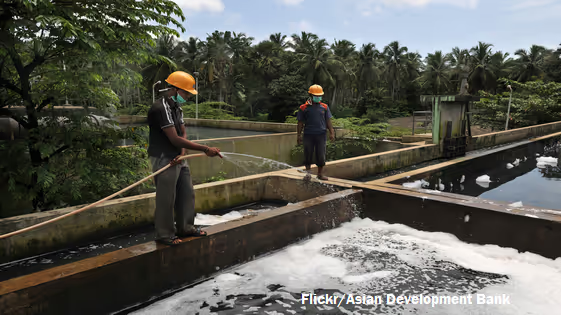
This note by Agrawal and Siva outlines efforts taken by the Prayagraj district in Uttar Pradesh to collect samples from sewage treatment plants and test them for the SARS-CoV-2 pathogen. They found a correlation between surveillance results and test results two weeks later, suggesting that wastewater surveillance can be used for early detection of the disease. They also highlight the potential to use wastewater surveillance to understand antimicrobial resistance, and to monitor diseases during large events.
Mainstreaming millets right: Dangers of promoting ultra-processed products
In the fifth post of the e-Symposium on ‘Carrying forward the promise of International Year of Millets’, Reshma Roshania argues that instead of relying on the ‘Big Food’ industry to increase the production and consumption of millets, policies should focus on making millets a vital part of government food schemes. She highlights the shortcomings of Production Linked Incentives in ensuring that the nutritious value of millets is realised, and suggests that rather than investments in startups, street food vendors and small-scale food outlets should be encouraged to provide millet-based meals and cater to rural markets.
Impact of fiscal decentralisation and ethnic heterogeneity on choice of local polity
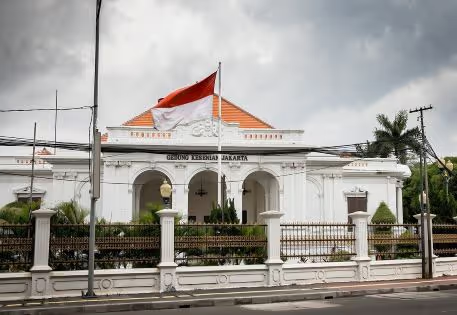
In this article, based on Chapter 7 of 'Decentralised Governance’, Mitra and Pal utilise Indonesia’s fiscal decentralisation to local communities in 2001 to examine how FD may differentially affect the choice of local polity and generate local political entrepreneurship in ethnically homogenous and heterogenous communities. Utilising local income and local development as proxies for local political entrepreneurship, they document that ethnically diverse electoral democracies were more effective to initiate political entrepreneurship in Indonesia, which in turn facilitated the alignment of diverse population groups.

Decentralised targeting of transfer programmes: A reassessment
Ahead of the release of ‘Decentralised Governance: Crafting Effective Democracies Around the World’, Dilip Mookherjee brings together some of the arguments against decentralisation of welfare programmes, including the incidence of political clientelism and elite capture, and summarises attempts made by developing countries to undertake hybrid ‘recentralisation’ initiatives. While acknowledging that direct benefit transfer (DBT) programmes can limit the scope for misallocation and corruption, he probes the ability of DBTs to be responsive to localised shocks and recentralisation’s implications for fiscal federalism.
Forest Rights Act: An account of contradictory conservation laws
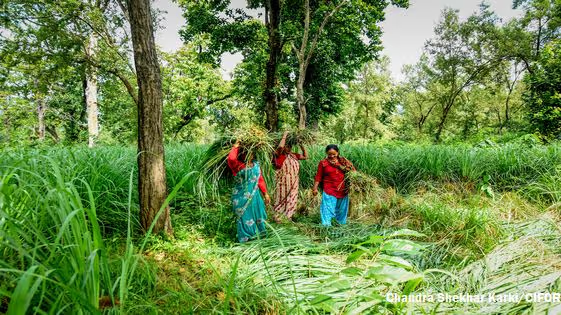
In the second of two articles about the implementation of Forest Rights Act, Bharti Nandwani uses data on land conflicts to investigate why land disputes increased after the introduction of FRA. She points to the prevalence of contradictory legislation, highlighting the case of compensatory afforestation funds which are disbursed in a way that encroaches upon land cultivated by forest dwellers. She emphasises the need to recognise the superior knowledge of those communities and give them the responsibility of managing and conserving forests
Forest Rights Act: Political participation of indigenous communities
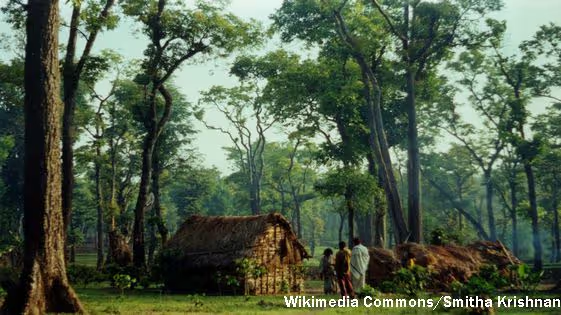
In the first of two articles about the implementation of Forest Rights Act, Bharti Nandwani looks at the implication of increased demand for land title recognition on political participation of Scheduled Tribes in Odisha. She examines possible channels through which the FRA can empower beneficiaries, such as through increased income or accessing grievance redressal, and suggests that recognising the rights of indigenous communities and increasing their access to welfare programmes could aid in conservation and reduce conflict.
Making the case for a common land registry
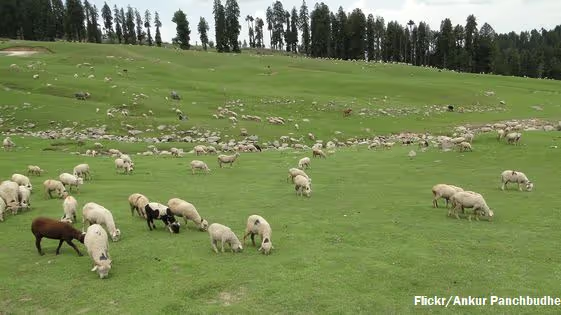
The lack of comprehensive data on India’s common lands affects conservation, resource use and land right conflicts. Chandran & Singh highlight the need for a national common land registry to reduce information asymmetry and increase transparency. They note recent developments and progress have been made by some state governments through digital mapping and engaging with local communities. They assert that key to the success of a land registry will be overcoming the fragmentation of state-level regulations with the central government’s guidance.
Facilitating risk-sharing through self-help groups in Bihar
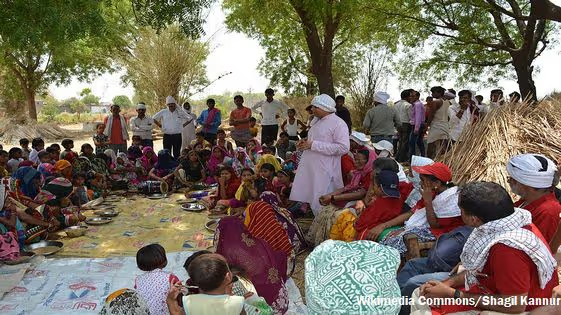
While the self-help group (SHG) programme in Bihar has improved access to low-cost credit for women, this article evaluates whether it improves risk-sharing by examining differences in village-level variance of consumption growth. It finds that improvements in risk-sharing occurred only in blocks with significant numbers of pre-existing SHGs. This suggests the importance of the programme’s administrative capacity in the form of a ‘community cadre’, that comprises members of existing SHGs and is responsible for the creation of new groups.

Sign up to our newsletter to be notified about the latest updates
.svg)
Just One Step Away!
Complete your signup to start getting the latest news, stories, and updates delivered straight to your inbox.