
.svg)
.svg)
%201.svg)
%201.svg)
.svg)

.svg)
.svg)

Building State capacity for accelerating development through effective governance
.svg)

.svg)


Governance

Impact of Bihar’s alcohol ban on intimate partner violence
This article examines the impact of a complete ban on the sale and consumption of alcohol in Bihar in 2016 on the incidence of intimate partner violence against women. Using NFHS data, it finds that after the ban, women in Bihar reported that their husbands were less likely to consume alcohol, and they were less likely to experience domestic violence. It also highlights the complementary role of self-help groups in increasing women’s empowerment and making them less susceptible to abuse.


Is electrification in India fiscally sustainable?
In the first article in the Ideas@IPF2023 series, Barnwal and Ryan describe the completion of household electrification in India as a fiscal feat, notwithstanding the persistent losses recorded by electricity distribution companies. They outline the extent of government investments in and bailouts of discoms, losses of revenue and electricity subsidies over the last decades, and propose Direct Benefit Transfers for Electricity as a policy solution based on the preliminary results of a pilot study carried out in the agricultural sector in Rajasthan and Punjab.

Institutionalising social audits: Lessons from Meghalaya
Sidharth Santhosh summarises key findings from Meghalaya's experience of mandating social auditing for welfare schemes, including the need for stronger coalitions between citizens and the state, and greater autonomy of the institutions conducting oversight. These findings are complemented by the experiences of bureaucrats and civil society organisations which engaged with the state government on the facilitation of the audits, and an analysis of the functional challenges of conducting audits.
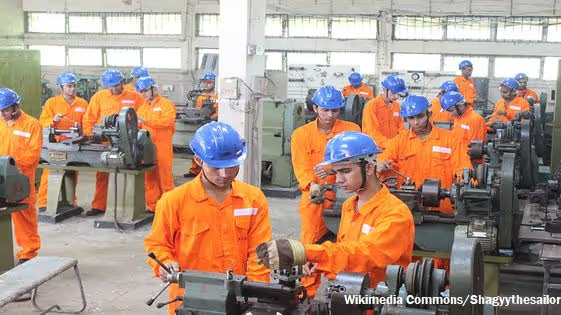
Unpacking how MSMEs are defined in India’s manufacturing and services sector
The Indian government announced a number of reforms to help micro, small and medium enterprises that had been affected by the Covid-19 pandemic – including changes in how an MSMEs are classified. Rahul Ranjan looks at the shifting classification of enterprises between the old and new definitions and delineates which industries in the manufacturing and services sector saw gains in micro-enterprises as a result of this change.

The costs of extreme competition for government jobs
Indian states have highly competitive examinations for public service recruitment, with many youth remaining unemployed for long periods to compete for these government vacancies. Kunal Mangal looks at the effect of a government hiring freeze in Tamil Nadu on candidate application behaviour and long-term labour market outcomes of candidates who were not selected. He suggests two policies for the recruitment process which can reduce the social cost of exam preparation
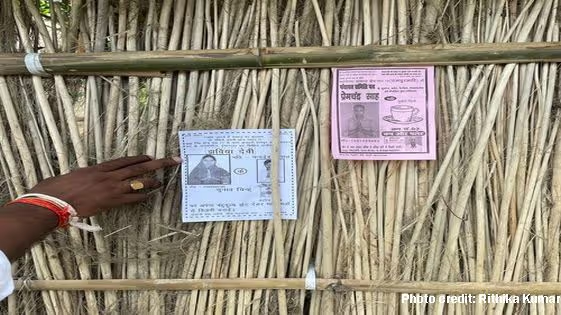
How women in politics impact maternal mortality
In the twelfth post of I4I’s month-long campaign to mark International Women’s Day 2023, Bhalotra et al. show that mortality during and after childbirth remains high, even where the knowledge and resources to avoid this are available, and demonstrate that raising the share of women in parliament can trigger action. Leveraging the introduction of gender quotas across developing countries, they identify reductions in maternal mortality, through increased skilled birth attendance and prenatal care utilisation, alongside a decline in fertility and an increase in schooling.
Has Budget 2023-24 been successful in balancing gender priorities?
Ahead of International Women’s Day, Tanya Rana and Neeha Susan Jacob categorise and analyse scheme allocations through the Union Budget’s Gender Budget Statement (GBS), by looking at what schemes various ministries and departments prioritise under the two parts of the GBS. They discuss issues of arbitrary classification, inclusion of schemes that are not entirely women-centric, and allocations that are inadequate to meet scheme objectives. They emphasise the need for monitoring and unambiguous scheme classifications to achieve financial priorities for women's empowerment.
Does being local matter? Administrative decentralisation and human development
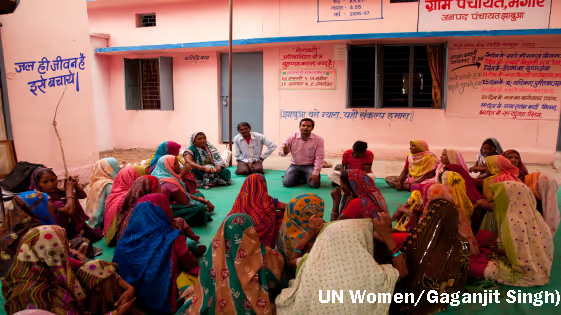
In this post, Chaudhary and Iyer discuss the administrative decentralisation reforms brought about by the Panchayati Raj Act, and measure the effect of decentralisation on the provision of public services and human development outcomes. States implemented these decentralisation reforms at different times, and to different extents. Their findings show that devolution of only functions to the local level, without a devolution of functionaries or funds, results in a decline in the quality of public service.

Analysing e-governance service delivery outcomes: Insights from eTaal
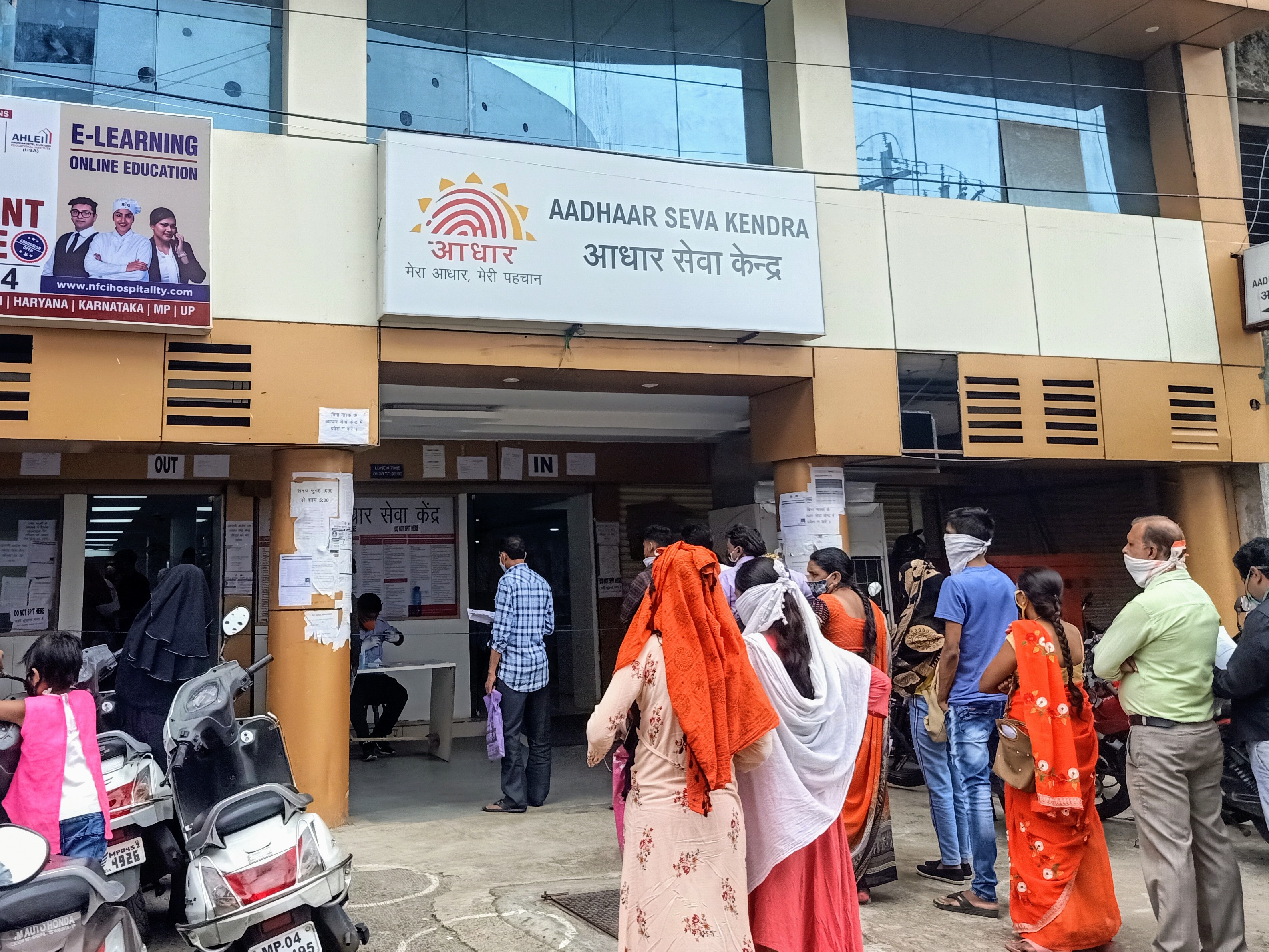
In this piece, Trivedi and Mumtaz attempt to analyse the performance of e-governance service delivery across different tiers of government and service categories, through the volume of end-to-end electronic transactions occurring during service delivery. They use the data aggregated by the eTaal portal to conduct a temporal analysis, and demonstrate an exponential growth in the adoption of e-governance services in India. They emphasise the pathway for bridging the gaps in e-governance service delivery through an accelerated, unified, platform-driven approach.


Sign up to our newsletter to be notified about the latest updates
.svg)
Just One Step Away!
Complete your signup to start getting the latest news, stories, and updates delivered straight to your inbox.