
.svg)
.svg)
%201.svg)
%201.svg)
.svg)

.svg)
.svg)

Building State capacity for accelerating development through effective governance
.svg)

.svg)

Governance

Improving admissions to technical colleges in India
Following their note on the issues that may arise from the ambiguity of EWS reservation policies, Aygün, Turhan, and Yenmez provide a critique of the multi-run deferred-acceptance algorithm currently used to implement de-reservation in the admission procedure of technical colleges. They outline three major limitations – the assignment of students to their less-preferred programmes, the potential disadvantage associated with reporting reserved category membership, and the scope for preference misreporting – and conclude by putting forth their own choice procedure for admissions to technical college programmes.



Challenges of executing EWS reservation efficiently
A recent Supreme Court judgement excluded members of reserved categories from the scope of EWS. Aygün, Turhan, and Yenmez look at the implications of this decision, including reserved category members having to choose between applying for positions on the basis of their caste or income, and the ambiguity about how EWS reservations are defined. They corroborate their findings with examples of recent court cases, and highlight the issues likely to arise with implementation, especially de-reservation.
Design choices for implementing affirmative action
In this expository piece, Ashutosh Thakur explains the various ways in which affirmative action policies can be implemented, and discusses the underlying tradeoffs and issues at hand. He delineates three implementation designs – hard cap, vertical, and horizontal reservation – in the context of poorly and well-performing candidates in hypothetical scenarios. However, in practice, the lack of detailed guidance has resulted in ad-hoc implementations of affirmative action policies that have long-lasting consequences for the political climate and legal discourse.
Introduction to e-Symposium: The architecture of affirmative action
The Supreme Court of India recently upheld an amendment that excluded Scheduled Castes, Scheduled Tribes and Other Backwards Classes from the Economically Weaker Section (EWS) quota, restricting it only to general category applicants. However, the specifics of how this reservation policy is executed can have important social and political implications. Across this week, from 12-16 December, this I4I e-Symposium brings together articles that provide a theoretical basis – using principles of market design, and search and matching theory – for more efficient implementation of reservation policies. Anchored by I4I’s Editor-in-Chief Parikshit Ghosh, the e-Symposium aims to open a discussion on the architecture of affirmative action, from the mechanisms of vertical and horizontal reservations, to ensuring efficiency in meeting diversity targets.
Panchsutras for carrying out a successful Governance Transformation
Following his last piece, which put forth a Governance Matrix that could be used assess a government system’s readiness to drive outcomes, Gaurav Goel puts forth five principles, or panchsutras, which are critical for the success of a governance transformation. Using the example of the Swachh Bharat Mission-Grameen, he shows that these principles are key to not only spurring the system into action, but also maintaining momentum towards achieving a goal, and ensuring long-term sustainability of the transformation

The panchayat asset register: An instrument to conserve India’s commons
With common lands making up nearly a quarter of Indian territory, the State has taken steps to protect them from encroachment. The Indian Constitution grants panchayats custodial rights to protect village commons. Chandran and Singh discuss the issues panchayats face in exercising this function, including the lack of knowledge or capacity to maintain asset registers of common lands. They suggest improving access to data and information, and institutionalising land audits to enable better governance of common lands.

The Governance Matrix: Understanding a system’s readiness for change
To explain the gap between the expectation of perfect outcomes and the reality of an imperfect system, Gaurav Goel puts forth The Governance Matrix, a tool which can be used to assess the readiness of a government to successfully implement initiatives. He explains the two axes – political salience and system capacity – along which political systems can move; based on this, he posits four states in which governments can exist, and examines the potential for sustainable change in each of the quadrants.

Time in office and gender gap in dishonesty: Evidence from local politics
Existing literature associates a higher share of women in politics with lower corruption; honesty is viewed as an inherent or static character trait. However, using information collected from 400 elected gram panchayat members in West Bengal, this study finds that spending time in office changes this – inexperienced women politicians are less likely to be dishonest than men, but this ‘gender gap’ disappears among experienced politicians. The study attributes this to reduced risk aversion and stronger political networks with experience.
Party preferences and strategic voting in India
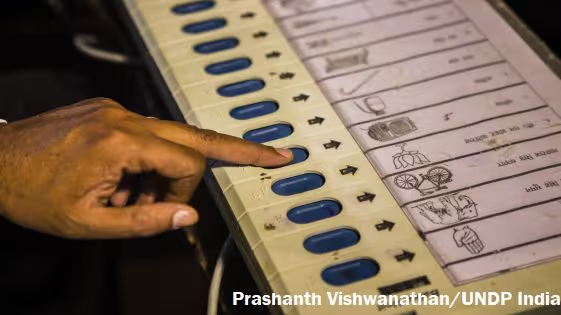
In the absence of compelling information that would allow them to accurately predict election outcomes in their constituency, many voters believe that their preferred candidate will win. Looking at voter preferences during the Uttar Pradesh assembly election in 2017, this article finds that very few Indians are 'strategic voters'. Instead, the results show that very few voters believed that they were in a position to vote strategically, as they expected their favourite party to win.


Sign up to our newsletter to be notified about the latest updates
.svg)
Just One Step Away!
Complete your signup to start getting the latest news, stories, and updates delivered straight to your inbox.