
.svg)
.svg)
%201.svg)
%201.svg)
.svg)

.svg)
.svg)

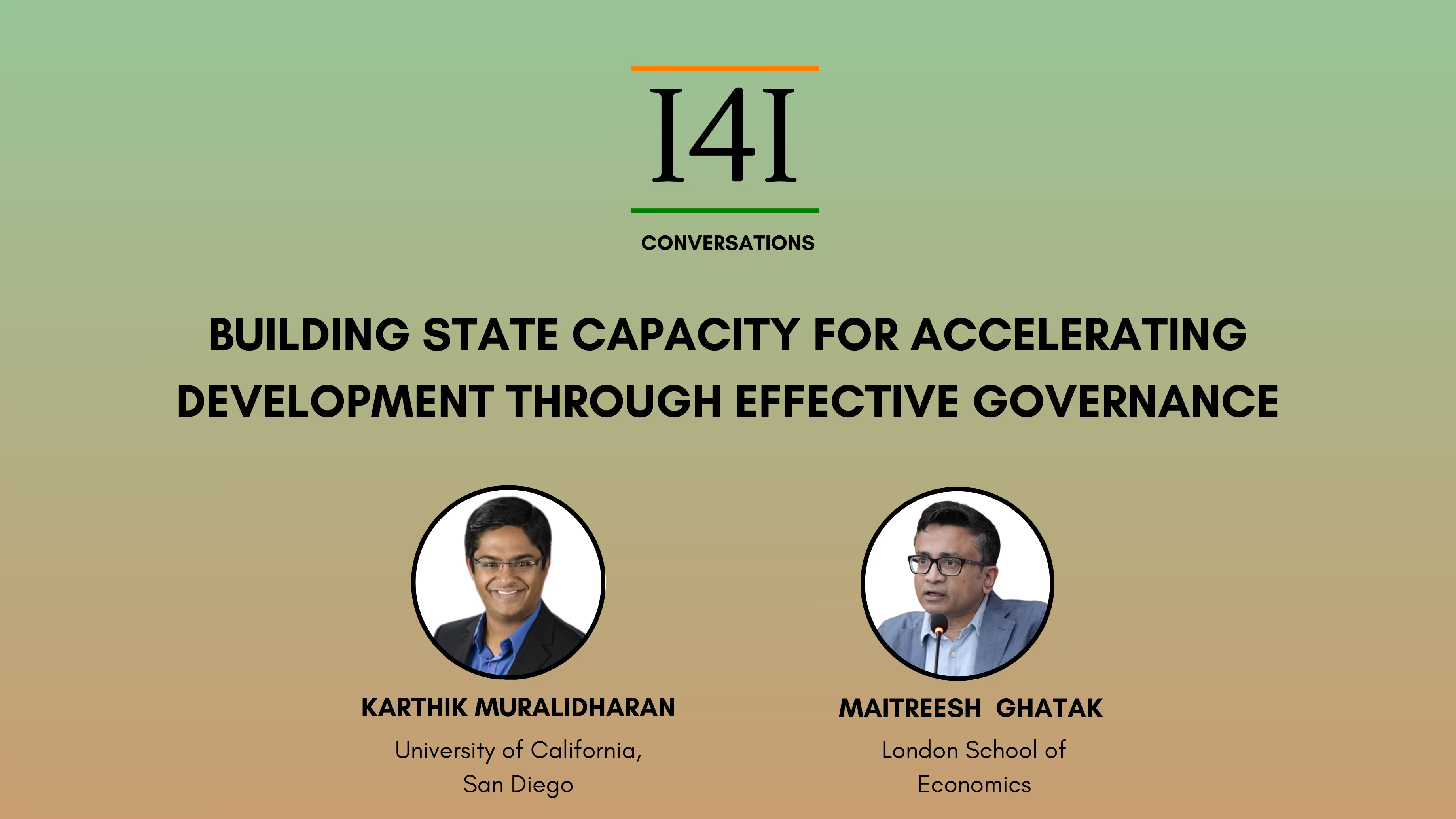
Building State capacity for accelerating development through effective governance
.svg)

.svg)


Governance

Out of power? Political capture of the Indian electricity sector
Although power generation has been growing exponentially in India, the quality of electricity supply remains poor. This article argues that political corruption is among the root causes behind unreliable electricity supply. Using data from West Bengal, it shows that billed electricity consumption is lower and actual consumption is higher for constituencies of the winning party after an election, as politicians systematically allow the manipulation of electricity bills.


Need for a choice-based approach in PDS
A large share of public spending on the Public Distribution System (PDS), India’s flagship food security programme, does not reach intended beneficiaries. Thus, the idea of Direct Benefits Transfer (DBT) in lieu of subsidised food has emerged as a leading policy alternative. Muralidharan, Niehaus, and Sukhtankar recommend a simple but powerful approach: rather than policymakers deciding between PDS and DBT, we could give beneficiaries that choice.
Evaluating Economic and Administrative Linkages in Determining Firm’s Location Choice in Hajipur (Bihar)
The purpose of this project is to understand the rationales of firms’ location choice in which complex decision making mechanisms are manifested by various factors. This project attempts to understand increase in the number of RMS by examining the location choice of RMS based on a case study of Hajipur, particularly in the context of economic and administrative linkages to Patna. The main hypothesis is that good governance, in the form of effective economic and administrative linkages are a significant factor in determining firms’ location and expansion.

Like father, like son? The economic impacts of political dynasties in India
Political dynasties remain ubiquitous in democratic countries even though many societies democratised to end hereditary rule. This article studies how dynastic politics affects economic development in India. It finds that the incentive to establish a dynasty encourages politicians to exert more effort and perform better in office. However, dynastic descendants perform worse than regular politicians because they inherit voters loyal to their family and face weaker performance incentives. This results in a ‘reversal of fortune’ development pattern.
Indian economy: High performer or Potemkin village?
The recent schizophrenic commentary on the health of the Indian economy raises questions on the true state: Is India doing really well or are we just seeing an impressive facade? In this post, Amartya Lahiri contends that the last four years blessed India with a wonderful external climate along with widespread domestic support for reforms to free up private enterprise. Having missed that opportunity we are reduced to parading ‘Potemkin villages’.
Are independent candidates unimportant for political representation?
Independent candidates are often deemed ‘frivolous’ or ‘spoilers’ by mainstream political figures and authorities, although there is little to no evidence on their effect on elections. This article finds that independent candidates decrease the chances that a Lok Sabha constituency elects a member of the party or coalition that forms the national government. It suggests that participation by independents has a high price – a lesser role for the constituency in policymaking
Bank and its critics
There has been a lot of commentary in recent weeks on the Reserve Bank of India, around its capital base, performance, and autonomy. In this post, Amartya Lahiri contends that RBI has a more coherent case on these issues than its critics. Central banks need to be adequately capitalised in order to perform their core functions, which include being the lender of last resort for the banking system.
Promoting women in grassroots governance: Strategies that work
There are more than a million women elected to the Panchayati Raj Institutions of local governance in India. Despite constitutional provisions, women face many barriers when they participate in local governance. In this post, Madhu Joshi highlights some interesting insights and strategies from a project to promote the participation and leadership of elected women representatives in four districts of Bihar.

Does choice of procurement contract matter for cost and quality of highways?
In the past, infrastructure projects in India have suffered from long delays, massive cost overruns, and poor quality of assets. A widely held belief is that public private partnerships (PPPs) can solve these problems. To examine this claim, this article compares the performance of PPPs with traditionally procured highway projects. It finds that project delivery is faster but construction costs are significantly higher for PPPs than for non-PPP roads. Moreover, quality of road surface is better for the former compared to the latter.


Sign up to our newsletter to be notified about the latest updates
.svg)
Just One Step Away!
Complete your signup to start getting the latest news, stories, and updates delivered straight to your inbox.