
.svg)
.svg)
%201.svg)
%201.svg)
.svg)

.svg)
.svg)

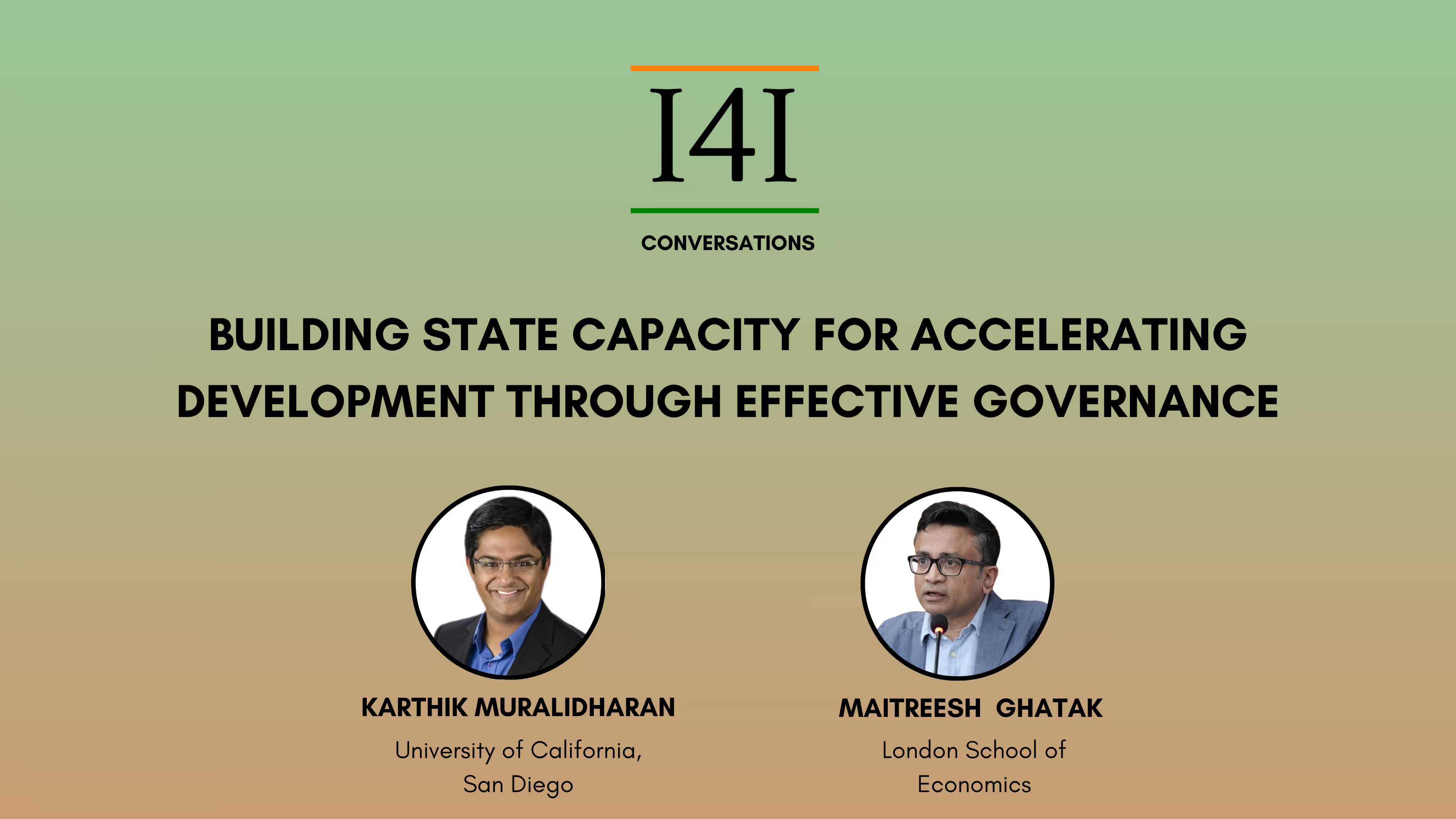
Building State capacity for accelerating development through effective governance
.svg)

.svg)


Governance

Food subsidy – PDS, cash, or both?
Should food subsidies – currently availed in the form of subsidised cereals – be given out in the form of cash instead? In this post, Krishna and Agrawal contend that rather than asking this binary question, it might be more cost-effective and welfare-enhancing to consider: where is PDS, and where might cash be, the better policy response for serving the same need?



Anganwadi: A workforce of women with a near-impossible mandate
With a workforce of 1.4 million women, the Anganwadi system forms the backbone of India’s Integrated Child Development Services Scheme – the world’s largest community-based programme for child development. Based on fieldwork in Odisha, Guruswamy and Kuruganti contend that there isn’t enough interest in understanding Anganwadi workers themselves – what drives them, their challenges, and what can be done to fully unleash their potential

How leader identity impacts group coordination
In principle, leaders can facilitate group coordination towards a common goal but in diverse societies, their effectiveness may depend upon their social identity, and how citizens react to leader identity. Based on a lab-in-field experiment in India, this article investigates the role of leader religion in improving coordination, and the effectiveness of two policies that are often used to aid disadvantaged groups: intergroup contact, and affirmative action.
Heart of darkness: Misplaced priorities of Jharkhand’s District Mineral Foundation
In 2015, the central government launched District Mineral Foundations in the districts affected by mining, which are mandated to collect royalty from all mining activities and use the funds for the welfare of the local population. In this note, Banerjee and Ranjan give an account of how lack of political commitment and misplaced bureaucratic priorities have led to dismal planning and implementation of the programme in the mineral-rich state of Jharkhand.
The Impact of Community-Driven Accountability on Land Rights Governance: Evidence from a Homestead Land Titling Initiative
How and under what circumstances can civic mobilization improve local governance and service delivery? This project seeks to contribute to debates on this question through a multi-method analysis of a homestead land entitlement support program in rural Gaya District, Bihar. This project evaluates Deshkal Society’s intervention with a research design composed of four components: Village-level randomized field experiment, Semi-structured interviews and focus group discussions with untitled SC households, Semi-structured interviews and focus group interviews with CBO members and Interviews with government officials and key informants.
Judicial Institutions and Economic Development: Examining Micro-evidence from India
This project examines the relationship between a country’s legal environment and its economic outcomes. This project will be constructing relevant measures of friction from trial level data at subordinate courts and examining its effects in a broader setting focusing on differential effects across formal and informal sector.

Do Indian voters mind their representatives getting rich in office?
Asset declarations, requiring politicians to disclose their financial information, are becoming increasingly common across the world. In India, financial declarations are part of public affidavits filed as a prerequisite for candidacy for political office. Using data from Indian affidavits, along with original experimental and survey data, this article examines how information on politicians' wealth accumulation may impact citizens’ evaluations of politicians and their voting behaviour.
How governance and public expenditure impact human development
The state of Madhya Pradesh displays wide variance in human development outcomes across its districts. This article examines the link between public expenditure, quality of governance, and human development in the state. It finds that development expenditure by itself is insufficient in achieving human development; public expenditure has better outcomes in districts with better governance indicators.

Do dishonest people gravitate towards the public sector in India?
The corruption level in the public sector may not only depend on punishments and systems put in place to deter corruption, but also on who chooses to enter the sector. This article finds that people who show dishonesty in a lab game both gravitate toward public service and engage in corruption once there. Modifying recruitment processes to screen out corruptible applicants may help ensure a cleaner and more effective bureaucracy.


Sign up to our newsletter to be notified about the latest updates
.svg)
Just One Step Away!
Complete your signup to start getting the latest news, stories, and updates delivered straight to your inbox.