
.svg)
.svg)
%201.svg)
%201.svg)
.svg)

.svg)
.svg)

Building State capacity for accelerating development through effective governance
.svg)

.svg)


Governance
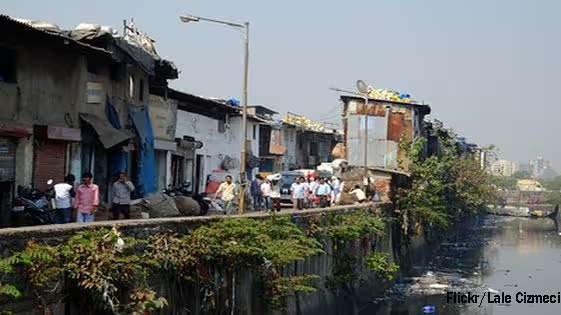
Citizen-State relations: Countryside and city
To what extent do citizens expect officials to respond to local problems, and how do they make demands on the State to advance their well-being? Based on surveys in Madhya Pradesh and Rajasthan, this article finds that urban slum residents are less likely to believe that they will get a direct response from an official, and more likely to report the presence of ‘political brokers’ – as compared to similarly poor rural residents.


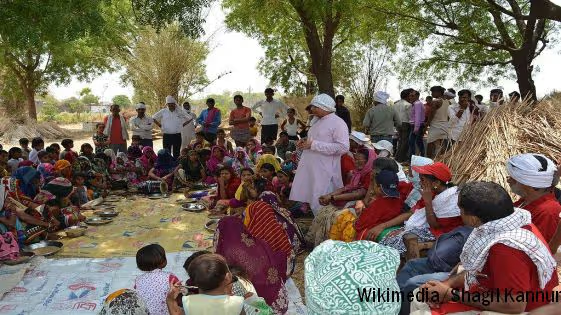
Does political reservation work, and for whom?
Does political reservation undermine or promote development, and for whom? This article presents an analysis of India’s Scheduled Areas, which reserve political office for the historically disadvantaged Scheduled Tribes. Focusing on the effects on MNREGA, it shows that reservation delivers no worse outcomes overall. There are large gains for targeted minorities, which come at the cost of the relatively privileged rather than other minorities.

Covid-19: Is it time to decentralise power?
Raghuram Rajan speaks to Econ Film’s CoronaNomics show, on the merits of de-centralised governance in the battle against the Covid-19 pandemic, how local authorities can be empowered, and the risk of a new financial crisis led by emerging markets.
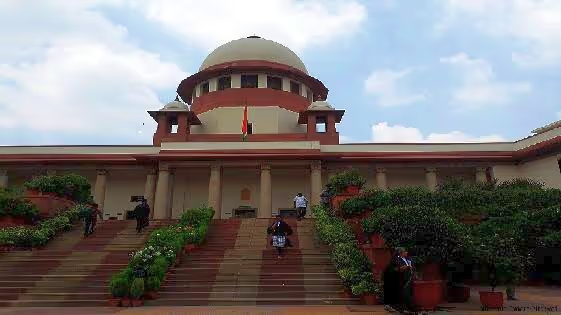
The politics of post-retirement appointments: Corruption in the Supreme Court?
The Indian judiciary bats for judicial independence. Wary of executive interference, judges ferociously protect their institutional turf. But does India’s judicial system suffer from an underhanded breach of judicial independence? Using a novel dataset of Supreme Court decisions between 1999 and 2014, and career trajectories of retired Supreme Court judges, this article finds that an increase in post-retirement appointments for judges to government positions acts as a powerful incentive for them to decide cases in favour of the State.

Court congestion, caste identity, and business performance
Effective contract enforcement is the key for the formation and expansion of business enterprises. But how does improvement in court performance matter differently to different caste groups? This article shows that the benefit of an efficient judiciary is higher for first-time entrepreneurs within communities that lack traditional informal business networks. This implies that besides other factors, improvements in court quality can be instrumental in enhancing social mobility.
Kerala’s management of Covid-19: Key learnings
Kerala was the first Indian state to be affected by Covid-19 with the highest number of cases at one point in time, but today it has a flat infection curve and one of the highest recovery rates in India. In this post, S.M. Vijayanand, Chief Secretary (Retd.) of the Government of Kerala, analyses Kerala’s experience in managing the Covid-19 crisis in the state and highlights critical takeaways for other states.
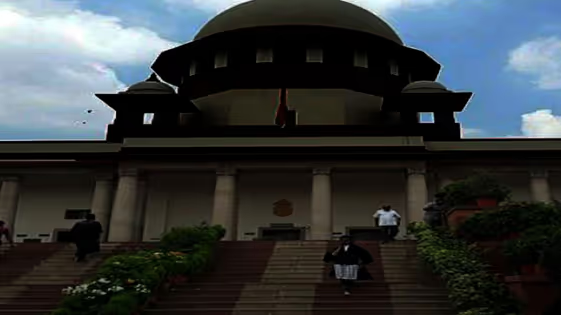
How district courts influence firm growth
The Economic Survey 2018-19 highlights that the single biggest constraint to ease of doing business in India is contract enforcement and dispute resolution, and increasing capacity in lower judiciary is crucial. This article estimates that adding one judge to a court with vacancy increases bank lending by 0.5% a year later, which affects credit availability, production, and profitability of firms located within the court’s jurisdiction.
Electoral cycles and incomplete public works projects: An analysis of the MPLAD scheme
The successful execution of public works programmes undertaken by governments often hinges on the completion of a vast array of local-level projects intended to create tangible amenities to improve the lives of citizens. However, in practice, a significant proportion of projects often remain incomplete. This article examines what drives incomplete projects under the Member of Parliament Local Area Development Scheme (MPLADS), a constituency development fund for public works projects in India.

There are none so blind as they who will not see
Based on Government of India’s own data, the government and the community of economists in India have come up with different narratives about the position of Indian economy. In this post, Pronab Sen highlights the differences between the two narratives. He also expresses concern over the kind of response government is taking to combat the current economic slowdown, which is fully consistent with its own narrative and completely ignores the other.

Sign up to our newsletter to be notified about the latest updates
.svg)
Just One Step Away!
Complete your signup to start getting the latest news, stories, and updates delivered straight to your inbox.