
.svg)
.svg)
%201.svg)
%201.svg)
.svg)

.svg)
.svg)
.svg)
.svg)

.svg)
Poverty Inequality
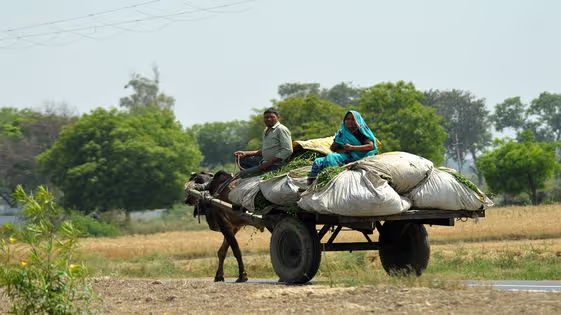
India’s rising ruralisation defies claims of declining poverty
Building on some of the key contributions to the Great Indian Poverty Debate, Dhananjay Sinha assesses the economic transformation in India over the past few decades. He outlines the lack of private capital expenditure and declining per capita income in India. He also discusses the growth of the agricultural sector, and how this increased ruralisation affects the demand for food grains and other consumer goods. With this evidence, he concludes that the claims of declining poverty may be unfounded.


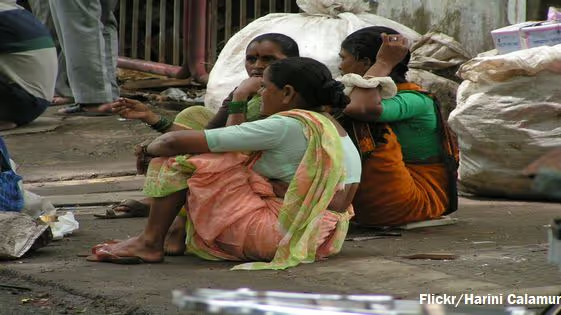
Finding the indiscernible poor: Community knowledge as a targeting approach
Varying estimates of poverty have often resulted in some deprived communities being excluded from government welfare schemes. Sabarwal and Chowdhry look at the case of Satat Jeevikoparjan Yojana in Bihar, which uses the mechanisms recommended by BRAC’s Graduation Approach and harnesses community knowledge to identify those living in extreme poverty and ensure that they receive access to social protection schemes. They discuss how this targeting approach takes into account non-monetary deprivation, and ensures the inclusion of women and marginalised groups.
Weighty evidence? Poverty estimation with missing data
Attempts have been made to estimate poverty in India with biased survey data, by adjusting household weights to remove the bias. Based on simulation exercises with artificially contaminated household surveys, Drèze and Somanchi illustrate the limitations of this method. Its ability to correct poverty estimates varies wildly, depending on the nature of the underlying bias, which may be hard to guess – there lies the rub. When the bias changes over time, estimating poverty trends becomes truly problematic.
Statistical priorities for the ‘Great Indian Poverty Debate 2.0’
In the final post of a six-part series on the estimation of poverty in India, Himanshu summarises attempts by researchers to estimate poverty using three varied approaches, given the lack of official consumption expenditure data. He considers the validity of recent estimates against the reality of declining wages. His view remains that if the outstanding statistical issues outlined here aren’t resolved, the upcoming NSS estimates on consumption expenditure will not end, but likely spark, a third round of the poverty debate.
Filling a gaping hole in the World Bank’s global poverty measures
In the fifth post of a six part series on the estimation of poverty in India, Martin Ravallion provides a non-technical summary of Roy and van der Weide's working paper. He discusses some of their main findings, which show that not only has the poverty rate continued to decline, but rural and urban poverty measures have been converging. He notes that although fewer people live at or near the consumption floor, the benchmark has not changed much since 2011.
Extreme poverty in India is yet to be eliminated: A comment on BBV
In the fourth post of a six-part series on the estimation of poverty in India, Sinha Roy and van der Weide reflect on the dramatically different estimates produced by two studies, and the source of the discrepancy. They put the estimates from the papers side by side in order to investigate three likely causes for this – using consistent data sources to determine pass-through rates, incompatibility in pass-through and growth rate series, and the incorporation of subsidies into the calculations of household expenditure.
The Great Indian Poverty Debate, 2.0
In the third post of a six part series on estimating poverty in India, Justin Sandefur considers the approaches employed for projections of poverty estimates since 2011-12 – the last year for which official estimates are available. He highlights the novel and creative solutions used by two recent working papers to fill the gap. But given other economic indicators and quality of National Accounts data, he expresses scepticism over the optimistic headline poverty figures proffered by both papers.
Has India eliminated extreme poverty?
In the second post of a six-part series on Gaurav Datt unpacks the claim that India was on the verge of eliminating extreme poverty, and questions two key assumptions on which it rests. Rather, he shows that the survey capture ratio has been declining, while top income shares have been rising over the last decade. He finally presents some alternative estimates, which call into question the elimination of extreme poverty.
Measuring poverty in the absence of Consumption Expenditure Survey data
In the first post of a six-part series on , Surjit Bhalla and Karan Bhasin discuss issues related to measurement of absolute poverty in India. They summarise their IMF working paper from April 2022, and defend their assumption of unity pass-through and impact of food transfers. They point out shortcomings in certain measurement approaches, including the World Bank’s reliance on the outdated Uniform Recall Period, and cite other poverty estimates which corroborate their own findings.
Sign up to our newsletter to be notified about the latest updates
.svg)
Just One Step Away!
Complete your signup to start getting the latest news, stories, and updates delivered straight to your inbox.