
.svg)
.svg)
%201.svg)
%201.svg)
.svg)

.svg)
.svg)
.svg)
.svg)

.svg)
Poverty Inequality
Introduction to e-Symposium: Estimation of poverty in India
Estimates of poverty in India put forth in two papers published earlier this year – by Bhalla, Bhasin and Virmani; and Roy and van der Weide – have sparked the “Great Indian Poverty Debate 2.0”. Across this week, from 3-8 October, this I4I e-Symposium brings together articles from the authors of the aforementioned papers, and commentaries from other contributors. They dissect the methodology employed by the two papers, and discuss the implications of the findings. Anchored by Maitreesh Ghatak, the e-Symposium aims to provide a nuanced view of the poverty estimates and what they truly say about the incidence and eradication of extreme poverty in India.



The implications of India’s spatial development
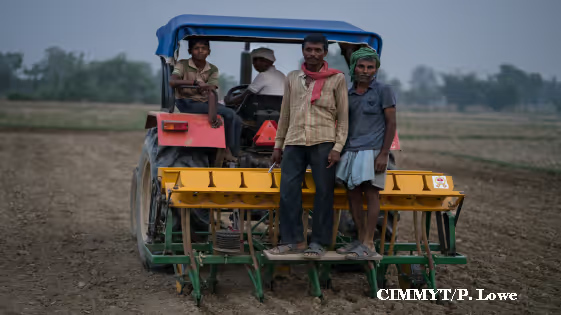
Mahatma Gandhi once said, “poverty is the worst form of violence”. In this piece, Ejaz Ghani highlights India’s poverty burden, its regional disparities and convergence thereof. He highlights how the growth process, as well as government transfers, currently benefit leading over lagging regions. He discusses how growth doesn't necessarily reduce poverty, and encourages policymakers to not wait to adopt direct interventions. He concludes with crucial policy suggestions around decentralization, labour mobility, and investments in agriculture to enable lagging regions.

How financial access impacts women’s decision-making role in households
Government programmes which grant women access to financial support often provide assistance which is too small to significantly impact women’s economic position within the household. This article uses data on loans granted to members of NRLP self-help groups and finds that increasing women's access to financial resources enhance their decision-making role within the household. However, only large loans have this effect, while providing women with small loans yields similar results to improving the financial position of the household.

The post-pandemic global inequality boomerang
Global inequality has fallen over the last three decades, despite a rise in inequality within some countries. This article uses a World Bank database covering the years 1981-2019 to posit that the decline in global inequality will reverse in the coming years, driven by the between-country component of inequality, with the unequal recovery from the Covid crisis likely to hasten the reversal. Thus, the narrative of declining global inequality could prove temporary
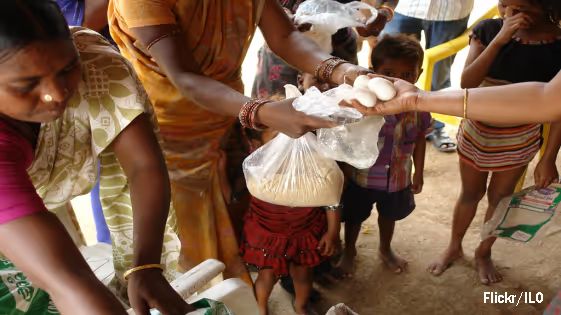
Urban exclusion: Rethinking social protection in India in the wake of Covid-19
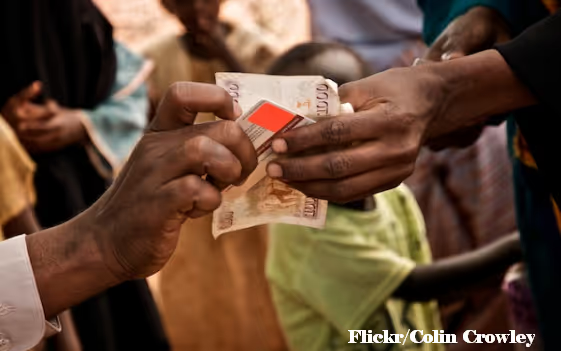
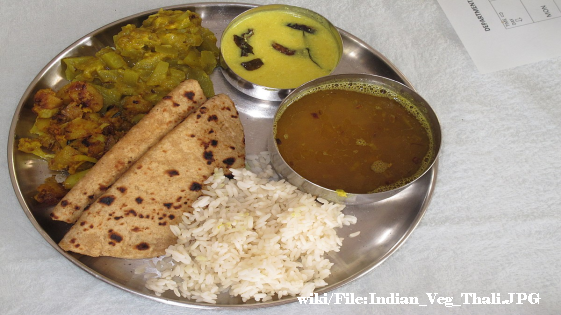
Economic insecurity caused by lockdowns during the early days of Covid-19 forced many households to rely on government welfare schemes to fulfil their consumption needs. Using data from the June 2020 round of the Delhi NCR Coronavirus Telephone Survey (DCVTS) by NCAER, this article shows that few households received both foodgrains and cash transfers, particularly in urban areas, and urban residents were also eight percentage points less likely to receive cash transfers vis-à-vis their rural counterparts.

Using personalised information delivery to improve uptake of emergency government benefits
Although many governments introduced additional benefits as part of existing welfare schemes for Covid-19 relief, there is often a significant gap between the introduction of, and access to these benefits. Based on a field experiment in Kanpur in Uttar Pradesh, this article shows that simple, low-cost, information provision interventions can improve the accuracy of households' beliefs about the entitlements they are eligible for and increase the amounts they actually receive, improving beneficiaries’ food security and well-being.
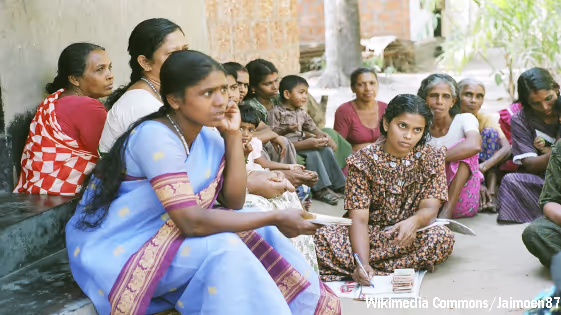
A microfinance model to enhance borrowers’ lifetime utility
Research has shown that providing credit along with services such as savings instruments, can increase the utility that borrowers obtain from credit. Presenting a theoretical model where microfinance institutions offer a ‘locked-in’ savings service and credit, this article shows that the optimal contract is one that enables a borrower to save up the lumpsum amount required to adopt a more efficient technology.

Examining Himachal’s urban employment guarantee
Despite proposals by economists on the need for an urban work programme in India, a national-level policy seems some time away from coming to fruition. However, some states have implemented such programmes and in this note, Krishna Priya Choragudi examines the case of Himachal Pradesh’s Mukhyamantri Shahri Ajeevika Guarantee Yojana. She contends that such schemes are an important step towards asset creation and livelihood security in urban areas, along with enhancing women's employment.

Covid-19 and long-term poverty: Evidence from rural Rajasthan
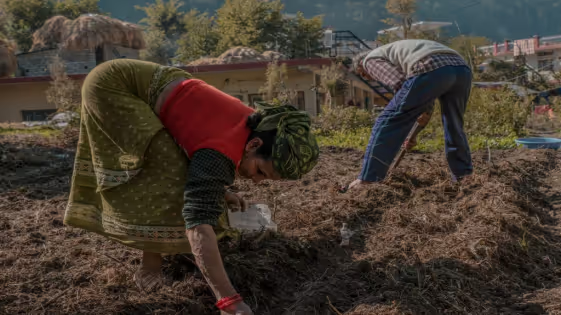
Based on preliminary calculations, it is being reported that 77-220 million have fallen into poverty in India on account of Covid-19, with the poor now accounting for 60% of urban, and 70% of rural residents. Based on a 2021 follow-up to a 2002 survey conducted in rural Rajasthan, this article shows that while households lost between one-third and two-thirds of their cash incomes during March 2020-August 2021, they experienced little to no change in long-term poverty.
Sign up to our newsletter to be notified about the latest updates
.svg)
Just One Step Away!
Complete your signup to start getting the latest news, stories, and updates delivered straight to your inbox.