
.svg)
.svg)
%201.svg)
%201.svg)
.svg)

.svg)
.svg)
.svg)
.svg)

.svg)
Poverty Inequality

Fatal oblivion: India's National Family Benefit Scheme
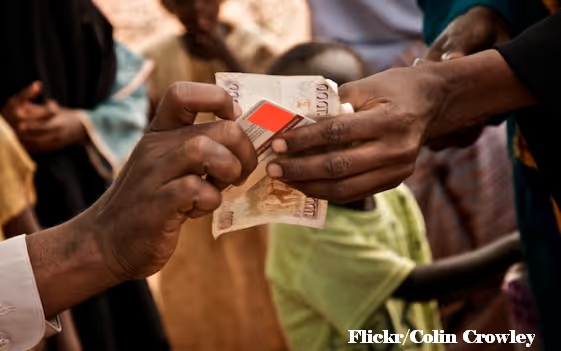
The National Family Benefit Scheme (NFBS) – which provides financial assistance to families in the event of the death of a breadwinner – has been plagued by low budget allocations, restricted coverage, and administrative hurdles. In this post, Jasmin Naur Hafiz examines these and other implementation issues facing the scheme, and advocates for revamping and consolidating this critical component of India’s social security framework.


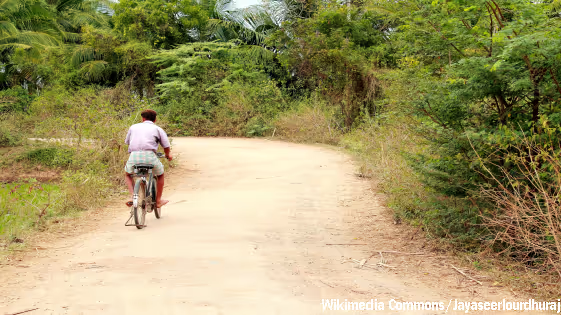
Crime in the village: Does road infrastructure make a difference?
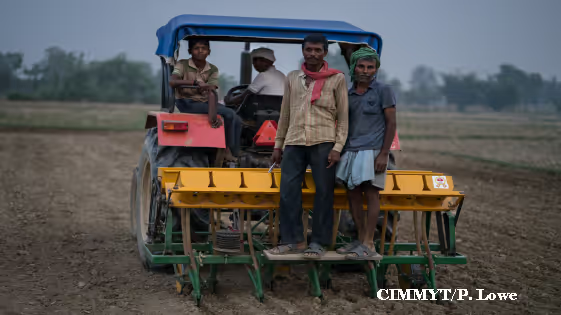
Access to better infrastructure is critical for poverty alleviation and economic development in rural India. Analysing data from the 2004-05 and 2011-12 waves of the India Human Development Survey (IHDS), this article shows that households in villages connected with pucca roads had better outcomes in terms of crime, labour force participation, and family income, relative to those residing in villages with no pucca roads.
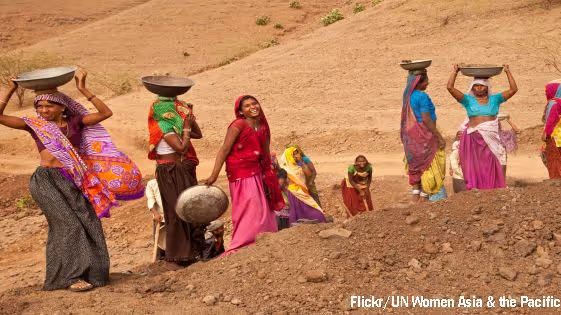
MNREGA funds allocation: Honouring the work-on-demand guarantee
The Centre has sought an additional Rs. 25,000 crore as funding for MNREGA (Mahatma Gandhi National Rural Employment Guarantee Act). Based on simple calculations using official data, Ashwini Kulkarni contends that the actual fund requirement is in fact much higher. As the pandemic continues to adversely impact rural livelihoods, the government should allocate sufficient funds to MNREGA, in order to honour the work-on-demand guarantee.

Covid-19: Impact on migrant workers in Bihar
The nationwide lockdown – imposed in March 2020 to contain the spread of Covid-19 – left large sections of migrant workers in a precarious position, with livelihoods lost, and no means of public transport to get back home. This note presents findings from a survey of over 1,600 households in 12 villages across seven districts of the state of Bihar – a major source of migrant workers – to assess the impact of the pandemic on their lives.
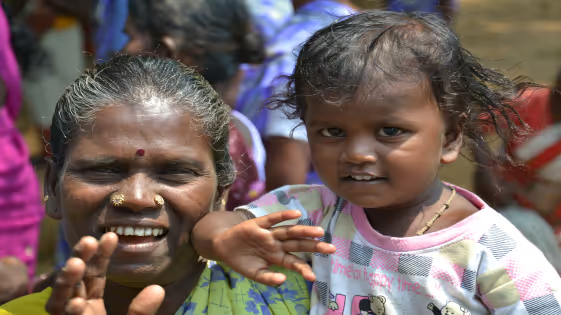
Not by growth alone: The salience of redistribution in poverty eradication
Recent studies posit that per capita incomes of developing countries are finally on track to catch up to those of industrialised countries. In this post, Enevoldsen and Pande contend that this country-level catch-up will not be sufficient to eradicate extreme poverty, as the blessings of this ‘growth’ are not reaching the poor. Inclusive prosperity requires a political solution: redistribution.

Covid-19: Impact on income inequality in India
Even as global inequality was falling, income inequality in India increased during 1990-2019. With the occurrence of Covid-19, the trend of increasing income inequality in the country is expected to not only continue but worsen. Analysing data from the Consumer Pyramids Households Survey, this article shows that inequality has risen sharply during the pandemic, with lower income households having experienced a larger decline in earnings.
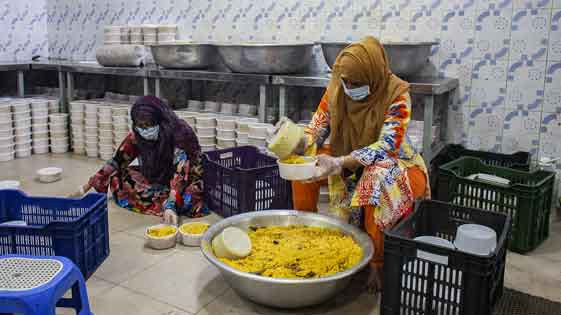
Covid-19 and growing food insecurity: Insights from rural Bihar
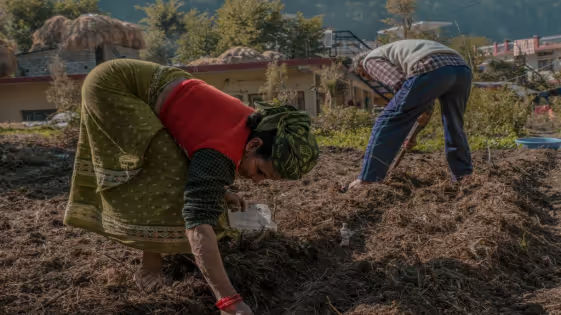
Emerging research shows that Covid-19 has had a devastating impact on the already undernourished and marginalised populations, by affecting their access to food and nutrition, and consumption patterns. In this note, Dutta et al. discuss findings from their field study in rural Bihar and highlight three key reasons for reduced food consumption by households – fear of contracting Covid-19, price hikes, and closure of markets.
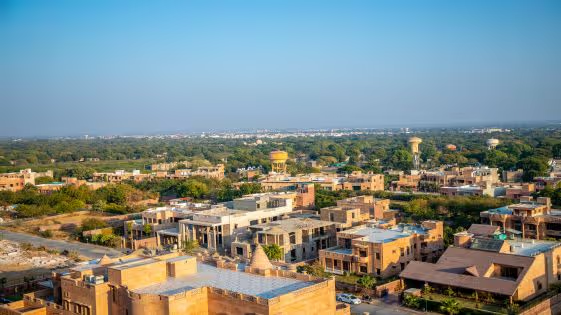
Spatial disparities in household earnings in India
The per-capita state domestic product of Haryana (India’s richest state) was 5.6 times that of Bihar (poorest state) in 2017-18, up from 3.8 in 1996-97. Differences in urbanisation levels and inability of poorer regions to realise agglomeration benefits, are cited as reasons for the lack of convergence across states. Using 2018-19 Periodic Labour Force Survey data, this article examines spatial disparities in household earnings across the country.
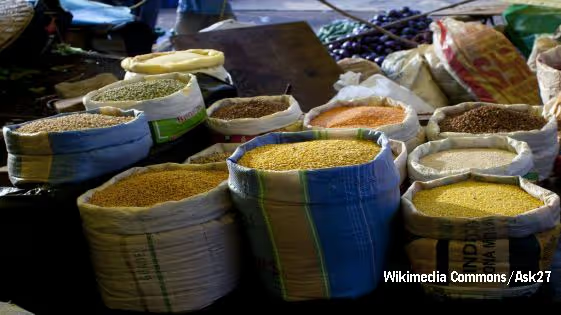
PDS, National Food Security Act, and Covid-19
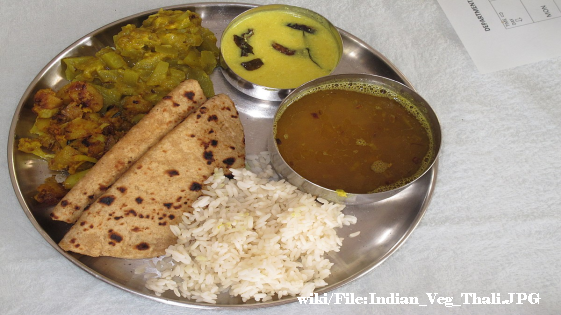
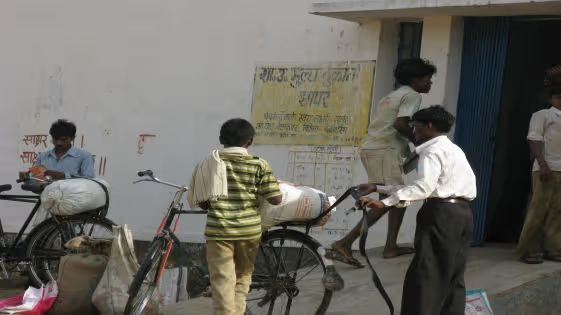
Introduced in 2013, the National Food Security Act (NFSA) brought about fundamental reforms in the public distribution system (PDS) and most importantly, declared a legal ‘right to food’. Based on a primary survey in Bihar, Odisha, and Uttar Pradesh, this article traces the changes in the PDS post NFSA, and during the Covid-19 crisis.
Sign up to our newsletter to be notified about the latest updates
.svg)
Just One Step Away!
Complete your signup to start getting the latest news, stories, and updates delivered straight to your inbox.