
.svg)
.svg)
%201.svg)
%201.svg)
.svg)

.svg)
.svg)
.svg)
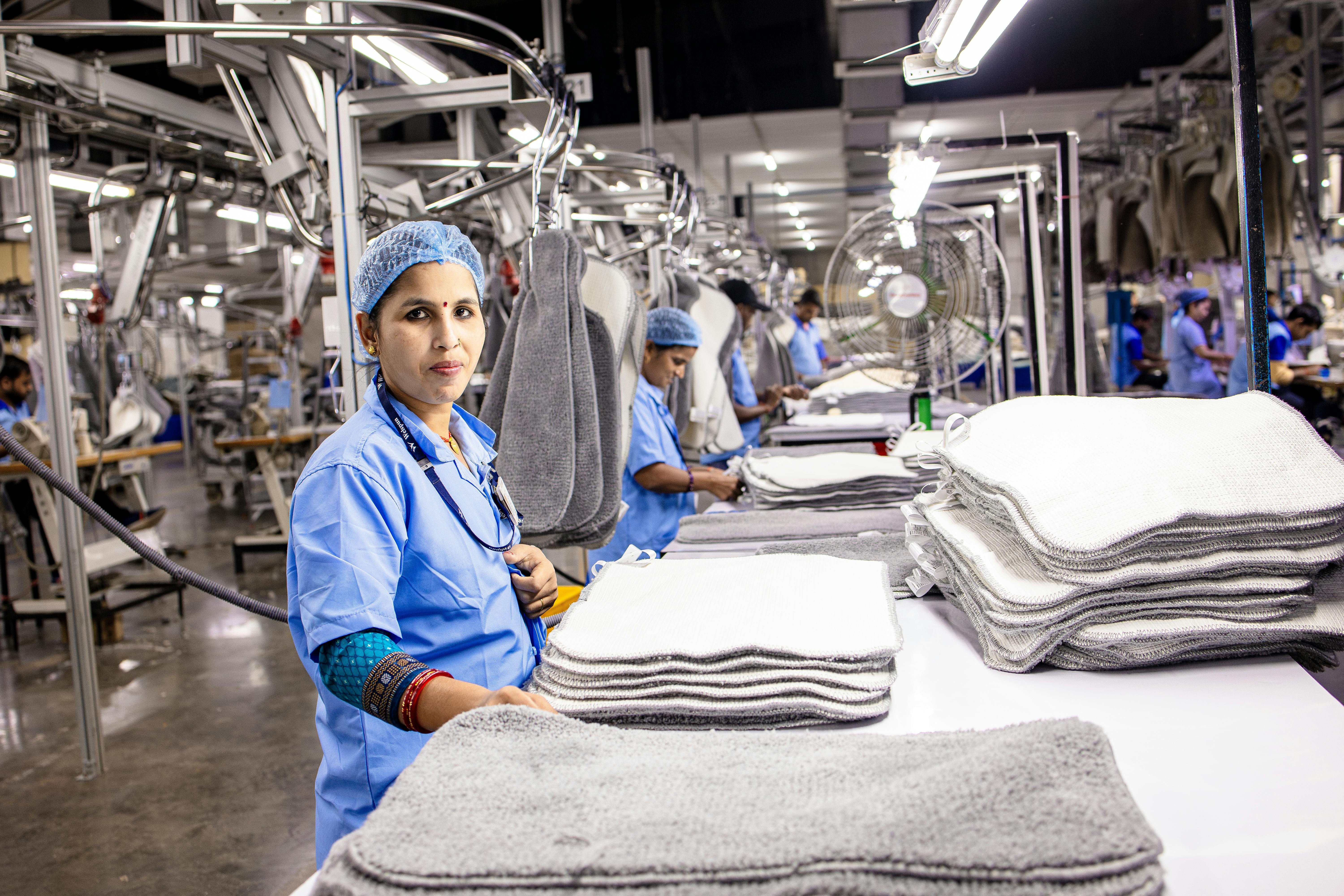
Night shift bans and female employment in Indian manufacturing
.svg)

.svg)



Productivity and Innovation

Leveraging digital labour markets to increase employment opportunities
India’s relatively young population, the pace of adoption of smartphones and digital technology, and rapid urbanisation has contributed to the growth of digital labour markets. In recent years, we have seen the proliferation of gig work and labour market platforms like Uber, Urban Company, Swiggy and others. This growth has accelerated in the wake of the Covid-19 pandemic with India currently accounting for 8% of the world’s digital labour platforms. In this edition of I4I Conversations, Prof. Farzana Afridi (Indian Statistical Institute) speaks with Dr K Rajeswara Rao and Dr Sakshi Khurana (NITI Aayog) to examine how job-matching technology platforms could be harnessed to increase employment opportunities, through skill-matching and technology-based job allocation. In reference to the NITI Aayog report ‘India's Booming Gig and Platform Economy: Perspectives and Recommendations for the Future of Work’, released on 27 June 2022, they discuss how the flexibility and low entry ...


Leveraging digital labour markets to increase employment opportunities
India’s relatively young population, the pace of adoption of smartphones and digital technology, and rapid urbanisation has contributed to the growth of digital labour markets. In recent years, we have seen the proliferation of gig work and labour market platforms like Uber, Urban Company, Swiggy and others. This growth has accelerated in the wake of the Covid-19 pandemic with India currently accounting for 8% of the world’s digital labour platforms. In this edition of I4I Conversations, Prof. Farzana Afridi (Indian Statistical Institute) speaks with Dr K Rajeswara Rao and Dr Sakshi Khurana (NITI Aayog) to examine how job-matching technology platforms could be harnessed to increase employment opportunities, through skill-matching and technology-based job allocation. In reference to the NITI Aayog report ‘India's Booming Gig and Platform Economy: Perspectives and Recommendations for the Future of Work’, released on 27 June 2022, they discuss how the flexibility and low entry ...
Hindu-Muslim integration and firm output in Indian manufacturing: Evidence from a field experiment
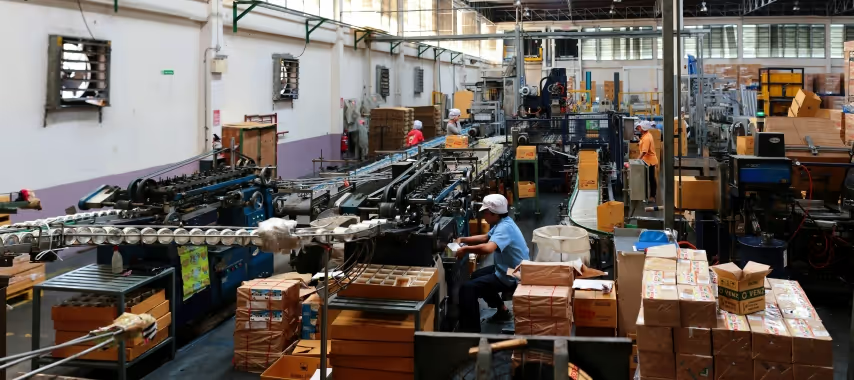
Evidence suggests that ethnic diversity can lower firm output due to poor social ties and taste-based discrimination among workers. Based on an experiment in a manufacturing plant in West Bengal, this article shows that religious mixing initially leads to lower team output in teams performing tasks requiring higher continuous coordination. However, this negative effect on productivity reduces in the longer run, with out-group attitudes improving vis-à-vis teams with lower continuous coordination.

Automation and inequality
Public discourse around automation has seen some take a fairly alarmist view – with concerns around its impact on employment, wages, the labour share of national income, and inequality. Others take a more optimistic view – that short-run turbulence and long-run increases in welfare are the typical outcomes of any technological change. In this context, Dilip Mookherjee (Boston University) speaks with Pascual Restrepo (Boston University) to discuss the evidence around the developed and developing country experience with automation, and whether the optimistic or alarmist view is bearing out in reality. Prof Restrepo outlines the definition of automation technology – differentiating it from ‘augmenting’ technologies – and contends, that like most things in economics, the answer lies somewhere in the middle of the alarmist and optimist views. They foray into discussing evidence on automation and technological change for developed countries: decline in the labour share of national income,,,

Automation and inequality
Public discourse around automation has seen some take a fairly alarmist view – with concerns around its impact on employment, wages, the labour share of national income, and inequality. Others take a more optimistic view – that short-run turbulence and long-run increases in welfare are the typical outcomes of any technological change. In this context, Dilip Mookherjee (Boston University) speaks with Pascual Restrepo (Boston University) to discuss the evidence around the developed and developing country experience with automation, and whether the optimistic or alarmist view is bearing out in reality. Prof Restrepo outlines the definition of automation technology – differentiating it from ‘augmenting’ technologies – and contends, that like most things in economics, the answer lies somewhere in the middle of the alarmist and optimist views. They foray into discussing evidence on automation and technological change for developed countries: decline in the labour share of national ...

Temperature, labour reallocation, and industrial production
While it is well-established that agricultural production is vulnerable to weather shocks, less is known about how those affected respond or the economic consequences of any responses. Analysing data from India, this article shows that higher temperatures are associated with reductions in agricultural production, employment, and wages – but workers are able to relocate to other sectors such as manufacturing within the district.
Trade, internal migration, and human capital: Who gained from India’s IT boom?
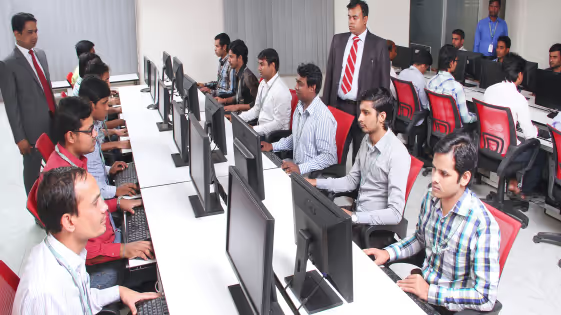
The Indian economy experienced trade expansion and an IT boom during 1993-2004. How did the spectacular growth in a high skill-intensive sector – concentrated in a few big cities – affect inequality across the country? This article shows that individuals born in districts with good access to jobs and education received welfare gains of 0.51% for every percentage increase in IT exports, vis-à-vis 0.05% in remote districts.

Debt contract enforcement and product innovation
Weak enforcement of debt contracts can have undesirable consequences for financial development, as difficulty in recovering claims from distressed firms causes banks to reduce lending. Leveraging the staggered implementation of debt recovery tribunals across Indian states, this article shows that the legal reform had a positive impact on product growth in firms – as such innovation require considerable upfront investment and access to credit.
Contract labour and firm growth in India
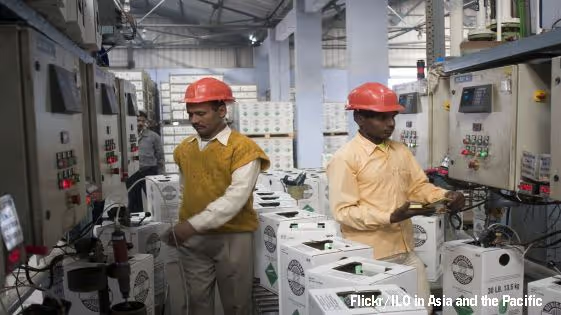
There is considerable evidence indicating that the Industrial Disputes Act (IDA), 1947 – which made it illegal for large companies to downsize – had a powerful disincentive effect for entrepreneurs in India. Using Annual Survey of Industries data, this article shows that constraints on large firms diminished since the early 2000s largely due to exploitation of a loophole pertaining to contract labour, rather than a de jure change in the labour laws.



Sign up to our newsletter to be notified about the latest updates
.svg)
Just One Step Away!
Complete your signup to start getting the latest news, stories, and updates delivered straight to your inbox.