
.svg)
.svg)
%201.svg)
%201.svg)
.svg)

.svg)
.svg)
.svg)
Night shift bans and female employment in Indian manufacturing
.svg)

.svg)
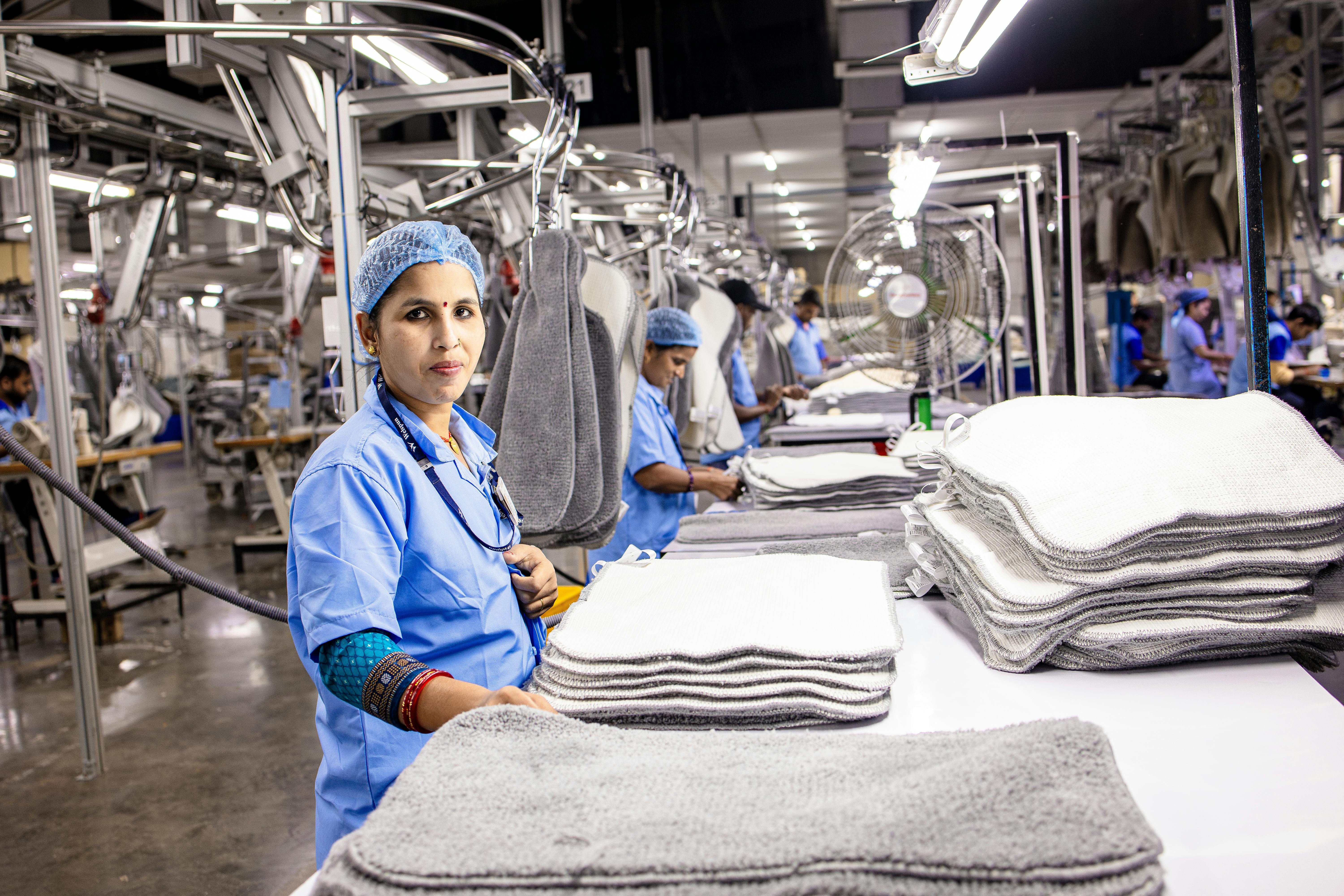



Productivity and Innovation
Intellectual property rights and wage inequality
Technology has become central to most everyday activities. But will incentives for technological change – such as those induced by Covid-19 – cause deeper distortions in the global economy, especially through wage inequality? To examine this issue, this article analyses data on Indian manufacturing firms during 1990-2006, and shows that stronger incentives for innovation through intellectual property resulted in inequality across virtually the entire economy.



Inequality, labour market trends, and the welfare State
All around the world, rising levels of inequality – particularly in the last 3-4 decades – have been recognised as a major issue. In this context, David Green (University of British Columbia) and Parikshit Ghosh (I4I Editorial Board; Delhi School of Economics) discuss various factors including trade and globalisation; gradual ideological shift to the 'right'; the changing nature of work – role of technological advancements, hierarchies created by higher education, and 'rents' rather than returns to skill. They also examine social protection – going beyond income support to also provide public services and foster communities, identifying rents in the economy to generate tax revenue to fund welfare, shifting from redistribution as charity to redistribution as justice and how Covid-19 can jumpstart this attitudinal change. This is the second edition of I4I Conversations.

Alleviating financial concerns to enhance worker productivity
Financial constraints can have psychological consequences and affect productivity by making workers more distracted during work. Based on an experiment among small-scale manufacturing workers in Odisha, this article shows that an interim payment before the end of the contract period raises worker productivity by 7.1% – with a higher increase of 13.3% for poorer workers– and also appears to improve planning and focus with a decline in attentional lapses.
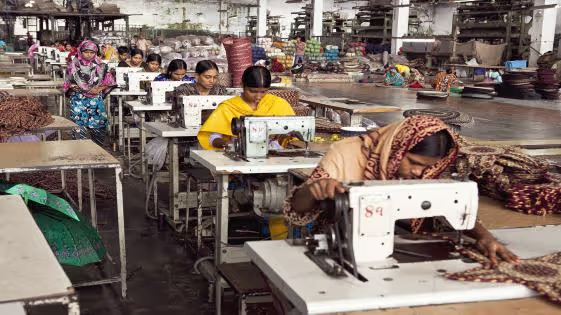
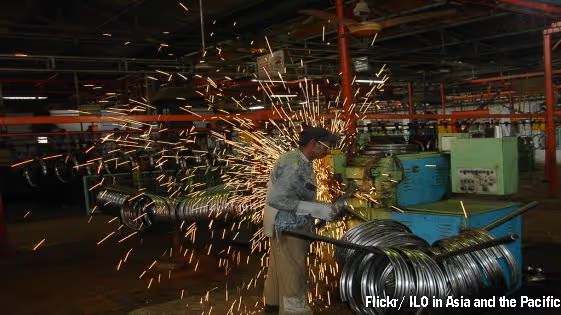
Dealing with worker absenteeism in labour-intensive industries
Worker absenteeism in labour-intensive industries causes productivity losses for firms, and reduced potential for productivity-based incentives for workers. Based on a study in Karnataka, this article investigates how factory line-managers trade workers amongst themselves when facing particularly low attendance on their lines, and estimates the financial gains that firms can make when they improve the distribution of workers across lines.

Short-term illness and intra-household labour substitution
For poor, agricultural households, health shocks strain limited resources on medical expenses, and result in loss of potential productive work-days. Based on data from rural India, this article shows that an illness episode causes a 7% decline in the ill individual’s average monthly wage income. Further, the male household head’s illness leads to the wife increasing her market labour supply by 3.2%, on average.

Covid-19 lockdown and migrant workers: Survey of vocational trainees from Bihar and Jharkhand - II
Covid-19 and the associated lockdowns have led to widespread job losses, and a subsequent exodus of migrant workers from the cities. In this note, Chakravorty et al. discuss findings from their survey of young vocational trainees from rural Bihar and Jharkhand. They highlight the severe impact on employment, increased informalisation, lack of re-migration, and disproportionate adverse effects on women.

Would a four-day work week benefit women?
In February 2021, the Indian government stated that it may allow firms the flexibility of having a four-day work week, while retaining the norm of 48 hours of work per week. In this post, Koustav Majumdar assesses the potential impacts of such a policy change on women and their workforce participation – given that women are known to disproportionately bear the burden of domestic work on a day-to-day basis.

Can technology mitigate the impact of heat on worker productivity?
Exposure to high heat causes productivity losses, with reduction in cognitive function as a key channel. A direct reduction in heat exposure via technologies such as air conditioning is not possible for outdoor tasks. This article presents results from a randomised experiment in Odisha where the use of a digital mode – rather than the traditional pen-and-paper mode – for household surveys helped mitigate some of these heat-induced productivity losses.
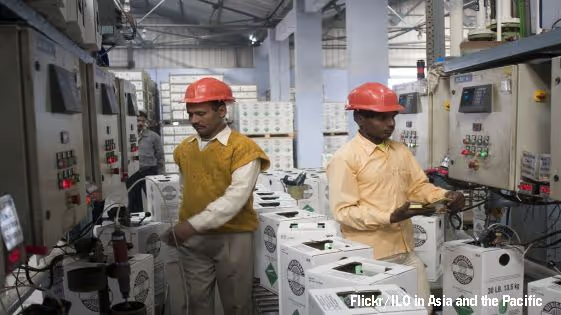
India’s new labour codes: A pre-condition for long-run growth
The Ministry of Labour and Employment has recently notified four new labour codes, which are expected to be implemented from April 2021. Assessing the impact of the policy changes around hiring-and-firing, trade union membership, and working hours, Aakanksha Shrawan argues that the proposed reforms would be game-changing both for domestic employers, and foreign firms who are contemplating investing in India.



Sign up to our newsletter to be notified about the latest updates
.svg)
Just One Step Away!
Complete your signup to start getting the latest news, stories, and updates delivered straight to your inbox.