
.svg)
.svg)
%201.svg)
%201.svg)
.svg)

.svg)
.svg)

.svg)

.svg)
Social Identity

An overview of (elder) son preference in India
In the fourth article in the Ideas@IPF2023 series, Seema Jayachandran presents key information about son preference and how it manifests as gaps in health and updates these outcomes with NFHS-5 data. She substantiates a more novel assertion on how elder sons are favoured and its consequences for other children, especially considering and the impact of declining fertility on sex-selection practices. She concludes with a discussion of the shortcomings of commonly employed policies intended to improve the sex ratio in India.


How class and caste influence school choice
Families' socioeconomic status impacts how parents make decisions regarding their children's education. Taking into account the interplay of caste and class, this paper finds that when families are too rich or too poor their caste identity does not affect their decisions about school choice. However, it is in the middle of the wealth distribution that caste identity matters most – students from disadvantaged castes whose parents are not as well connected in the labour market see lower returns to education.
Hindu-Muslim fertility differentials in India: An update
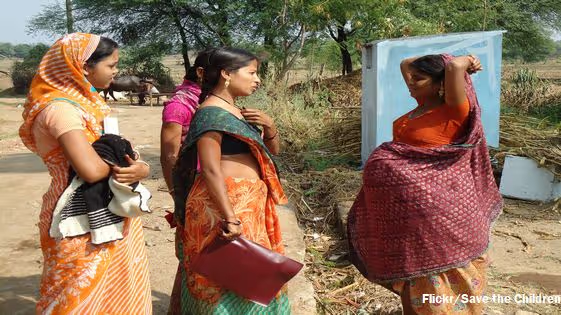
Building on past research, Saswata Ghosh and Pallabi Das estimate the state- and district-level fertility differentials between Hindus and Muslims using data from the latest round of the NFHS. They show that although the fertility transition has advanced further in most states during the last decade, and fertility rates between Hindus and Muslims have also converged, some regional variations persist.
The complexity of female empowerment interventions
In the final post of I4I’s month-long campaign to mark International Women’s Day 2023, Siwan Anderson unpacks the complex dimensions and interactions between measures of female empowerment. She highlights the sobering and unintended perils of policy interventions that aim to increase women’s economic and political empowerment or change gender norms. She urges policymaking to remain mindful of the backlash within families to women’s expanded economic prospects, the benchmarking and transplanting of gender norms from developed countries and measures to build capacity to make political quotas effective

Sign up to our newsletter to be notified about the latest updates
.svg)
Just One Step Away!
Complete your signup to start getting the latest news, stories, and updates delivered straight to your inbox.